Connected. Scalable. Built for users.
Web and mobile app development
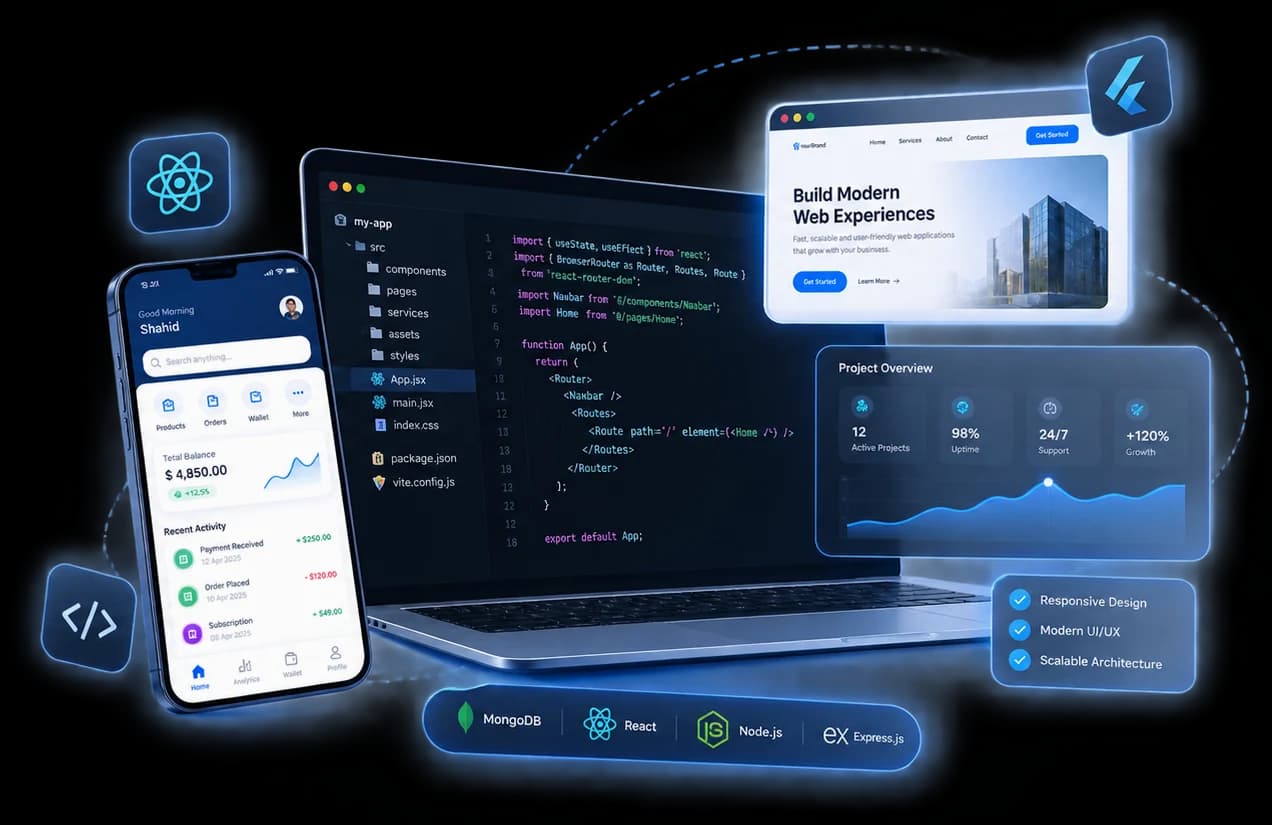
Dashboards, mobile apps and commerce apps, built on MERN with React Native and Flutter, with modern interface design and a production backend behind them.
What this covers
iOS and Android apps
One codebase, both stores. React Native or Flutter.
React Native and Flutter, one codebase serving both platforms, released to the App Store and Google Play. Native modules where a feature genuinely needs them: camera, biometrics, background location, offline storage and push notifications. Which of the two frameworks a project uses is a decision about the app, not a house preference.
Custom dashboards
Live data, roles and exports, built for the person using it all day.
Admin panels, operator consoles and client-facing analytics, built in React and Next.js against a Node and Express API. Roles and permissions, live data, filtering, exports and charts that read at a glance, designed around the person who has it open for eight hours rather than around the screenshot.
E-commerce apps
Browse, pay, track, with Stripe and the major gateways.
Browsing, cart, checkout, order tracking and account management on a phone, with Stripe and the major payment gateways, push notifications for delivery and offers, and a backend kept in step with the storefront the products already live in.
Integrations and release
The parts nobody demos, and everybody needs.
Payments, analytics, messaging, CRMs and hardware, wired in and tested. Then the release itself: store listings, review submissions, staged rollouts, crash reporting and over-the-air updates, so shipping the second version is not a repeat of shipping the first.
Built with
- React Native
- Flutter
- Next.js
- Node.js
- Express
- MongoDB
- Firebase
- Stripe
How a project runs
- 01Discover
- 02Define
- 03Design
- 04Develop
- 05Validate
- 06Deploy
- 07Evolve
Questions
One app for both platforms, or two?
One, in almost every case. React Native and Flutter both cover the great majority of what a business app needs, and going fully native is a decision we would make for a specific technical reason rather than by default.
Can it talk to the systems we already run?
That is most of the work. Payments, analytics, messaging, CRMs and hardware integration are the normal case, not the exception.
Do you handle the App Store submission?
Yes. Store listings, review submissions and staged rollouts are part of the build, not something handed over as a task at the end.